


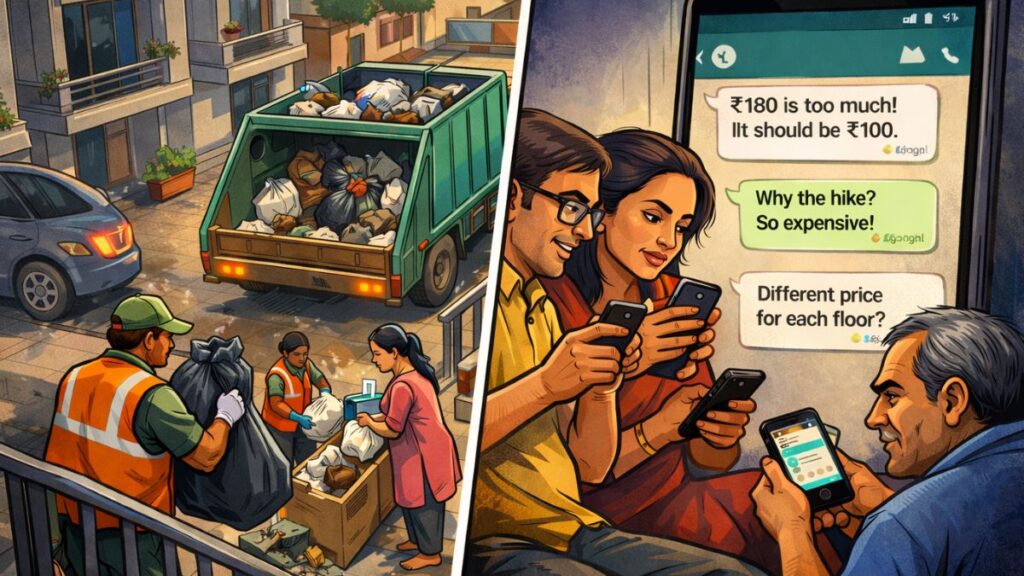
In the past few days, I watched a curious argument unfold in my residential discussion group on WhatsApp. The issue on the table was not electricity tariffs, rising petrol prices, stray dogs roaming freely and biting in the society, property taxes, or the US Iran war. It was something far smaller in monetary or current affairs terms, yet far more revealing in what it exposed about our mindset.
The debate revolved around the monthly payment for garbage collection. In our area, garbage collection is done by a contractor through around 20 people. The Residential Welfare Association (RWA) president shared a letter stating the price of garbage collection would increase from Rs 150 to Rs 180 from this month. The letter suggested the new price as Rs 200 per month, but the RWA president said they had “negotiated” it down to Rs 180.
As soon as the announcement was made, all hell broke loose. Several residents objected to the price rise and suggested reducing the price to Rs 100. Some even suggested different prices for different floors. Overall, they claimed that the modest increase of Rs 30, that too after a gap of three years, was unreasonable. Voices grew louder over a difference that, for most households, would barely be noticed in their monthly spending.
What struck me was not the amount being debated. It was the reasoning behind the resistance. Many of the same people opposing the increase are salaried professionals. They expect increments every year. They complain when companies delay salary revisions. They discuss inflation, rising expenses, and the need for fair compensation.
However, when the conversation shifts to sanitation workers who collect their garbage every morning, the logic suddenly changes. The argument becomes simple. Why should they be paid more? This contradiction reveals something uncomfortable about how we view certain kinds of labour.
Inflation affects everyone
It is a fact that inflation does not spare anyone. The price of vegetables, fuel, school fees, and rent rises for everyone. A sanitation worker buying groceries in the same market pays the same price as a bank employee or a software engineer. If payments for essential services remain frozen for years, the real income of those doing the work actually declines. What may have seemed reasonable five years ago gradually becomes inadequate.
In most professions, this is recognised as basic economic reality. Employers revise salaries periodically. Governments adjust pay scales. Even private contracts often include provisions for revision over time. But when the conversation turns to sanitation work, that logic mysteriously disappears. A modest increase suddenly becomes controversial.
Work that everyone depends on but few respect
Garbage collection is one of those services people rarely think about until it stops. I remember a few months back, the main person got injured and had to take a 15 day break from work. Those who work under him created chaos as they missed several houses every day. The chaos turned into long discussions on the WhatsApp group and repeated calls to the main person, let’s call him Vijay, despite the fact that everyone knew he was on bed rest.
The moment waste is not picked up for a few days, the consequences become obvious. Overflowing bins, foul smells, stray dogs tearing open garbage bags, and the risk of disease quickly remind everyone how essential the service actually is. Yet the workers who perform this task every day handle the dirtiest part of urban life. They deal with rotting waste, broken glass, hazardous materials, sanitary napkins, diapers, and unhygienic conditions that most people would refuse to confront even once.
It is physically demanding work. It is unpleasant work. And it is work without which modern neighbourhoods simply cannot function. Yet discussions about fair payment for this labour often become the most contentious.
A simple question worth asking
Whenever such debates arise, one simple question should be asked. If your own employer announced that your salary would remain unchanged for years despite rising living costs, would you quietly accept it? Most people would not.
They would argue for a raise. They would cite inflation. They would point to the increasing cost of daily life. They would explain why their work deserves better compensation. Some would even be ready to go on strike. But when sanitation workers ask for even a small revision, the reaction is often entirely different. Suddenly people begin calculating every rupee.
Dignity cannot exist without fairness
In public discourse, we often speak about respecting labour and recognising the dignity of work. Governments launch campaigns praising sanitation workers. Social media fills with messages celebrating those who keep our surroundings clean.
But dignity cannot survive on words alone. True dignity requires practical recognition. Fair payment is one part of it. Equally important are proper working conditions, protective equipment such as gloves and masks, and the assurance that the people doing this work are treated with basic respect.
Expecting individuals to handle society’s waste while denying them even modest financial fairness sends a troubling message about how we value labour.
The mindset problem
The debate that revolved around small increases in sanitation payments is rarely about affordability. For most middle-class households, the difference is too small to meaningfully affect their monthly budgets. But I must not forget that among these, there are several families that did not want to pay even Rs 150 and regularly threw their garbage in the field next to the society wall.
The farmer who owns that land requested the families personally and the RWA president repeatedly not to throw garbage on his land, but nothing happened. Every family simply refused to accept that they had thrown the garbage there. He then installed a camera and caught several families doing so repeatedly. He came, showed the videos, and had a heated argument. So much so, the matter almost reached the point where he had decided to file a police complaint. Only after that did they stop throwing garbage on his land.
You may think they were not well-off families. The truth is that most of them own flats that cost around Rs 50 to Rs 60 lakh. Money is not the problem. Perception and mindset are. While some people think that if their house is clean, everything is fine and the surroundings do not matter, others consider certain kinds of work less worthy of fair compensation. The people performing those jobs become invisible unless something goes wrong.
But the cleanliness of our streets, neighbourhoods, and homes rests on the shoulders of workers who perform tasks many of us would never agree to do ourselves. Recognising that reality requires a small shift in perspective.
If we truly believe in the dignity of labour, then fairness should not stop at the professions we personally respect. It must extend to the work that keeps our communities functioning every single day. Sometimes, the way we argue about a few rupees reveals far more about society than the amount itself.
You can read this article on X here.