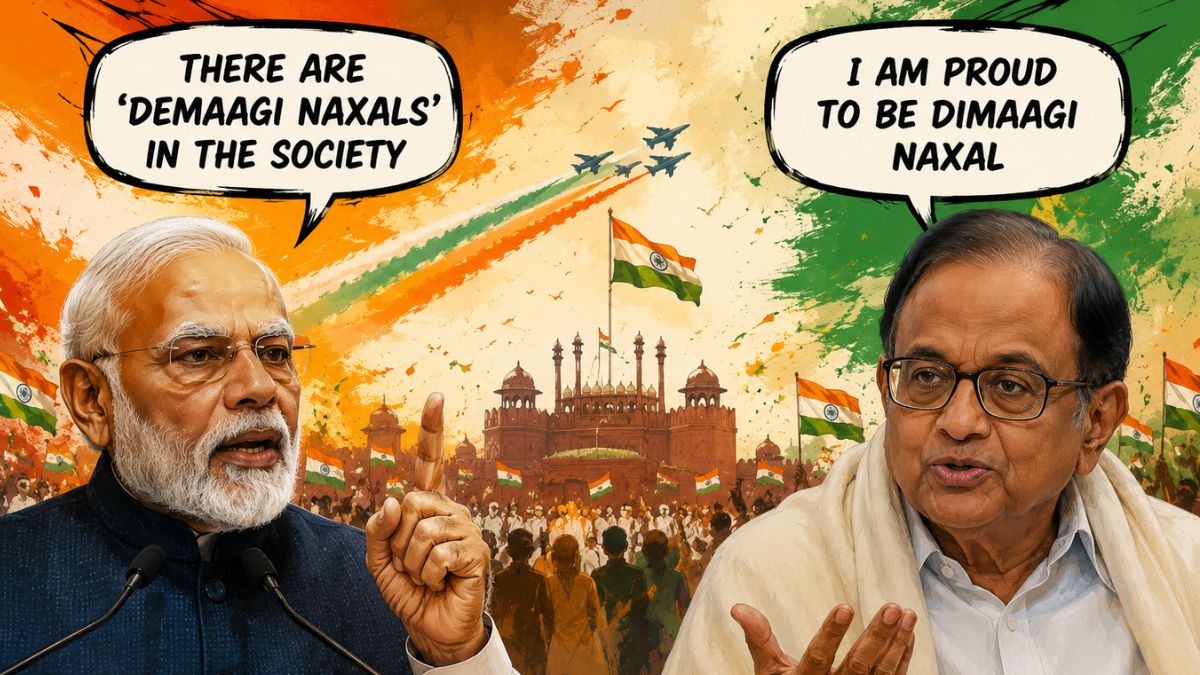
If someone calls you a Naxal, it is obvious that you will feel insulted. It should be seen as an accusation that you are working against India’s interests. But that happens only in a decent world. In Indian politics, every accusation eventually becomes either a hashtag, a T-shirt or a matter of pride.
On Independence Day, Prime Minister Narendra Modi used the term “dimagi Naxal” from the Red Fort. As expected, the political response did not disappoint. Former Union Minister and senior Congress leader P Chidambaram declared that he was proud to be called a “dimagi Naxal”. Several other leaders in the Opposition and members of the Left-Liberal gang objected to the expression used by PM Modi and questioned whom he was targeting.
हथियारी नक्सल तो गए, लेकिन दिमागी नक्सल समाज को गलत राह पर घसीटने के लिए भांति-भांति के दांव आजमा रहे हैं। इन्हें पहचानकर आइसोलेट करने के साथ ही देश की युवा पीढ़ी को विकसित राष्ट्र बनाने की मुख्यधारा से जोड़ना होगा। pic.twitter.com/C8ynOwYHoy
— Narendra Modi (@narendramodi) August 15, 2026
Amid all this, I am sure Maggi Masala must have felt threatened. After all, Maggi spent decades perfecting the art of producing something in an instant. However, Indian politics has now beaten it.
The Opposition has only one job nowadays. Take something PM Modi said. Add two cups of outrage. Sprinkle some Tharoor-style vocabulary. Add a generous spoonful of “democracy is in danger”. Stir vigorously on social media and, before Maggi can soften in the pan, a new political identity is ready.
To be honest, Maggi cannot be made in two minutes. It is a marketing gimmick. However, when it comes to cooking “outrage” over what PM Modi said, two minutes are more than enough!
Chidambaram said, “I am proud to be a dimagi Naxal.” But my question is, “Proud of what, exactly?” This is where the recipe becomes interesting. If PM Modi meant to call someone a “dimagi Naxal” merely because they disagree with him, there are probably several crore dimagi Naxals in India. After all, the total vote share of the Bharatiya Janata Party (BJP) was around 37%.
In a vibrant democracy like India, governments have opponents, journalists criticise politicians, academics disagree with policies and citizens vote governments in and out. BJP stayed because people trust PM Modi. Not the party, the person leading the party. People’s trust in Narendra Modi is strong enough to the point that he has not lost an election since his political career began in February 2002.
The expression used by him refers to people who intellectually sanitise, rationalise or romanticise an ideology associated with an armed insurgency that has killed civilians, policemen, security personnel and political workers. How the expression irked the Opposition and Left-liberals to the point that they are “proud” to be called one is a curious response to begin with.
Those who have lived through Congress rule must remember that even they were against Naxalites and tried to use ruthless force against them. But the “urban Naxals” among the Congress party always won and resisted the action. However, I did not expect a leader like Chidambaram to claim that he is proud to be a “dimagi Naxal”. Maybe he did not understand the term, which is possible considering his, well, company in the party.
I am proud to be a dimagi naxal !
— P. Chidambaram (@PChidambaram_IN) August 16, 2026
Ideally, this is where one should stop and ask, “Hang on, what exactly am I claiming to be proud of? Am I talking sense?” But stopping to read the ingredients ruins instant food. Our politics increasingly operates on Maggi Masala principles. The packet arrives first; understanding can be added later. Opposing whatever PM Modi says is actually the MSG of Indian politics. It is not good for health, but it tastes GOOD!
When PM Modi coined the term “andolanjeevi”, everyone raced to call themselves one. When PM Modi made the term “urban Naxal” popular, within hours the expression simultaneously became an accusation, an insult, a political identity and a publishing opportunity. Now PM Modi has used “dimagi Naxal”, and instead of first establishing what constitutes one, we have volunteers claiming the designation.
I think this is the political equivalent of walking past a police station, seeing a poster warning “Beware of pickpockets” and announcing, “How dare you! I am proud to be one!”
Perhaps they meant that they are proud to be dissenters. Excellent. Use the word “dissenter”. Perhaps they are proud to oppose PM Modi. Perfectly legitimate. Everyone has the right to oppose the ruling party and its leader. But say you are a Modi critic. Perhaps they are proud to be Leftists. India has had Left-wing intellectuals, parties and governments for decades. Say Left-wing or Leftist.
I do not understand the itch to enthusiastically adopt “Naxal”, even with the cerebral upgrade of “dimagi”, unless the objective is simply to transform whatever PM Modi says into the newest flavour of resistance. There lies the real comedy.
I believe that Indian political discourse has reached a stage where leaders sometimes allow their opponents to manufacture identities for them. The opponent supplies the terminology, they supply the outrage, television supplies the debate and social media supplies the seasoning.
But no one is interested in learning what is inside the packet. Perhaps that is why “Dimagi Naxal” and Maggi Masala belong together. One is supposed to involve the mind. The other only requires two minutes. Increasingly, our politics seems determined to prove that even two minutes is too long to think.