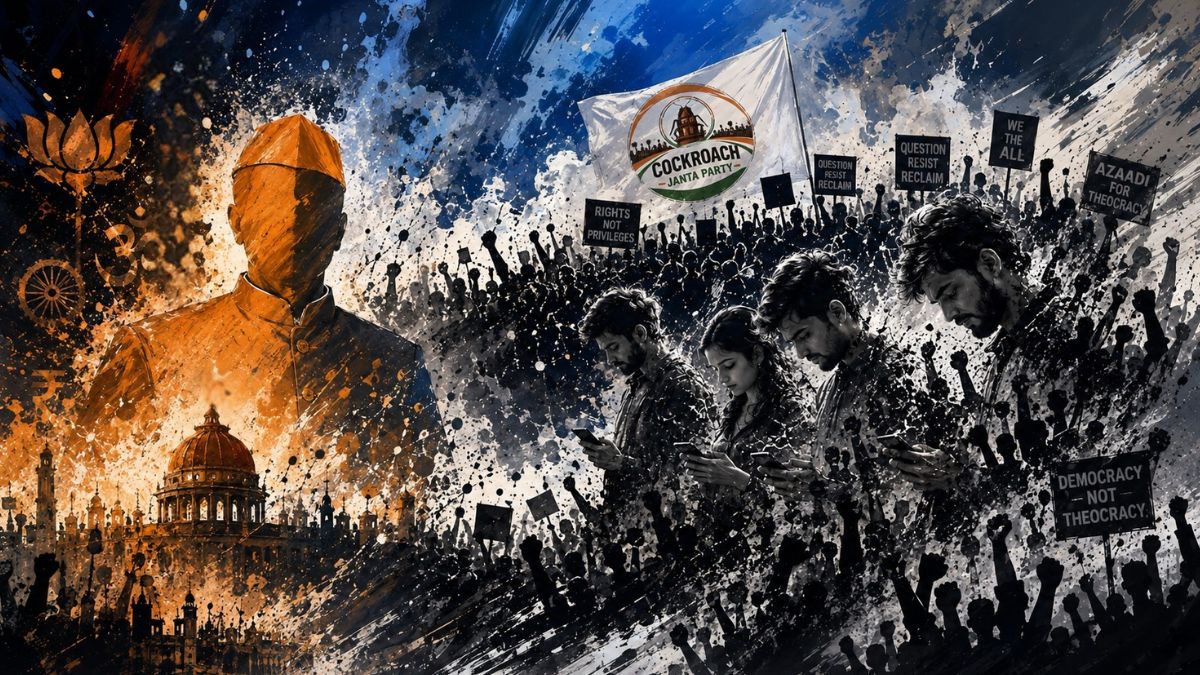
In the past couple of months, a political agitation produced a familiar claim. People who described themselves as “right-wing” or “apolitical” extended support to the Cockroach Janta Party (CJP), a political satire that claimed to launch a “student protest” against former Education Minister Dharmendra Pradhan. By the time the agitation ended, it had become larger than political affiliation. The “change of heart” among many who supported CJP was presented as the result of extraordinary circumstances that had temporarily or permanently overridden their usual ideological preferences.
However, I do not see it that way. In my view, a simple agitation, even if it involves students, cannot change anyone’s ideology. The most it can do is expose their true ideology. Those who supported CJP did not suddenly cross from one political side to another because of a single issue. Their response revealed that their deepest political instinct was never primarily right-wing. It was anti-establishment. They may have appeared committed to the political right because that side offered access, recognition or material benefit. Once sidelined, the borrowed identity collapsed.
Yes, in this world of uncertainty when it comes to political and ideological affiliations, people change parties, leaders, slogans and voting choices. What I do not believe they can change is their political temperament. If they claim they have done so, they are just being opportunistic, and it has nothing to do with the sentiments they have towards an ideology or a political party.
Supporting an issue is not supporting a movement
The government could have mishandled the issue. It could have delayed action, underestimated public anger and failed miserably to communicate properly. Criticising such failures would not make anyone less right-wing. However, supporting an issue is not the same as supporting the movement that claims ownership over it.
A person could have said that the government was wrong while keeping CJP under scrutiny, especially when those who are affiliated with the satirical party or founded it have shown their political preferences many times since the beginning. A person could have questioned its leadership, methods, political connections and long-term intentions. He could have demanded corrective action without allowing the movement to present itself as the sole representative of public concern.
However, many did not do that. They accepted the movement’s framing and treated the political backgrounds of those involved as insignificant. For me, that cannot be seen as political neutrality. Choosing to completely ignore political affiliations is itself a political choice.
To me, it is very simple. If a reported connection with AAP suddenly stops mattering because the person is opposing the government, the real priority has become clear. Opposition to the establishment matters more than ideological consistency. Such a person did not support CJP despite his politics. He supported CJP because his politics was fundamentally anti-establishment.
There are no ideologically apolitical people
I do not believe that there is any such thing as an ideologically apolitical person. The word apolitical is often used for people who do not follow elections, party debates or daily controversies. It is then assumed that they possess no political preference until an event forces them to take a position. That assumption in itself is false.
A person may not know the names of ministers or party spokespersons. He may never attend a rally or publish political opinions. However, he still has instincts about authority, social order, protest, nationalism, religion, hierarchy, punishment, welfare and the role of the state. Those instincts are political even when the person does not recognise them as such. An event does not create these instincts. It forces the individual to rank them.
When public order clashes with street mobilisation, which one does he instinctively defend? When an elected government faces organised pressure, does he examine the demands or celebrate rebellion? When a movement claims moral superiority, does he scrutinise its organisers or suspend judgement because they are confronting power?
The answers reveal an ideology that already existed. What we call an apolitical person is often only someone whose politics has not yet been tested. The first major conflict does not transform him. It gives him an occasion to display what was already there.
When anti-establishment politics resembles right-wing politics
When it comes to anti-establishment politics, I see it as the missing explanation in many such cases. Some people have appeared right-wing for years because the establishment they opposed was dominated by the Congress, the left or institutions hostile to Hindu interests. Their anti-establishment instinct and right-wing politics seemed to point in the same direction.
When the political right is outside power, opposing the establishment can look identical to supporting the right. The difference becomes visible only when a right-wing government becomes the establishment. The individual is then forced to choose between a declared ideological identity and the deeper desire to side with whoever challenges authority.
A person whose politics is rooted in civilisational conviction may criticise the government without endorsing every movement raised against it. A person whose politics is rooted in opposition to power will eventually find the challenger more attractive than the ideological camp he previously claimed to support.
This is why a single agitation can make several supposedly right-wing voices appear to change. I do not think their ideology evolved in a matter of days. The circumstances simply separated two tendencies that had previously travelled together.
Borrowed political identities
Not every false political identity is deliberately dishonest. Some people inherit politics in the same way they inherit habits, cultural preferences or social networks.
They support the party preferred by their family. They repeat the opinions common among friends. They adopt the language rewarded in their workplace. They learn which views bring approval and which ones create discomfort. Over time, social belonging is mistaken for ideological conviction.
Such an identity can appear stable for years because it is rarely tested. The person remains surrounded by people who reinforce the same labels. He may believe that the borrowed position is his own.
The person breaks away and describes the moment as ideological evolution. I see it differently. The earlier preference was never deeply held. The conflict merely weakened the pressure that had kept the borrowed identity in place. He did not become something new. He stopped performing what others expected him to be.
Transactional political identities
There is also a less innocent category. Some people adopt political identities because those identities offer benefits. The benefit may be employment, access, visibility, patronage, contracts, appointments, invitations or proximity to influential people. It may be online attention or career advancement. Ideological language becomes a currency used to purchase relevance.
As long as the person is rewarded, his loyalty appears absolute. He defends decisions he would otherwise question. He attacks critics as enemies. He presents personal access as proof of political commitment.
A denied position, an unanswered request, exclusion from an inner circle or the loss of public relevance can produce sudden moral clarity. The person begins to discover faults that were always visible. He describes resentment as disillusionment and personal disappointment as political awakening. Again, I do not see ideological change here. I see the end of a transaction.
Some political identities are inherited. Others are rented. The inherited identity disappears when social pressure weakens. The rented identity disappears when payment, access or recognition ends.
When sidelined supporters turn hostile, they often claim that the political side betrayed its principles. Sometimes that criticism may be valid. Yet the timing can reveal that the person’s loyalty was conditional. He did not leave an ideology after changing his beliefs. He left a relationship after it stopped benefiting him.
Political conversion is political exposure
The usual objection is that lived experience can genuinely turn a left-wing person into a right-wing one, or the reverse. I reject that claim. Experience does not manufacture a new moral architecture. It exposes contradictions between the label and the instincts beneath it.
A person may spend years speaking one ideological language because that language is familiar, fashionable or useful. When experience makes the pretence unbearable, he abandons the label. Observers call it conversion because they saw the declaration. They did not see the disposition that had always resisted it.
People certainly revise opinions. They may change their positions on laws, leaders, elections or policies after learning new facts. That is not the same as moving from one fundamental ideology to another.
To me, ideology is the hierarchy through which a person interprets authority, society, identity, justice and conflict. Individual opinions sit within that hierarchy. They can move without transforming the underlying structure.
A right-wing person can oppose a right-wing government’s action. An anti-establishment person can support that government temporarily. A transactional supporter can speak the language of conviction for years. None of these temporary alignments changes the deeper preference.
Political events act like pressure tests. They strip away convenient labels, social expectations and profitable associations, compelling people to choose which instinct matters most.
In the CJP episode, I did not see right-wing or apolitical people transcending politics. I saw people revealing which political instinct had always been dominant. Some were anti-establishment. Some had borrowed their politics. Some had adopted a side for benefits and later felt sidelined. Their true colours were not created by the agitation. They became impossible to hide.
I therefore do not see political conversion as genuine ideological evolution. I see it as exposure, recognition or the collapse of a borrowed or transactional identity. Events may change the language people use and the side they publicly support. I do not believe they change the political temperament underneath.
People do not evolve from one genuine ideology to another. They change affiliations, explanations and public performances. What looks like conversion is usually recognition, exposure or the collapse of an arrangement.
The event does not change the person. It reveals the side that was always right for him.